



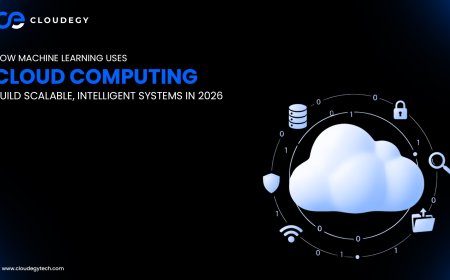







How Machine Learning Uses Cloud Computing: Build Scalable, Intelligent Systems in 2026
Learn how machine learning uses cloud computing for scalability, data processing, and real-time analytics. Explore benefits, use cases, and best practices in 2026.

Machine learning (ML) is at the core of modern technology, enabling systems to learn from data and make intelligent decisions without explicit programming. From recommendation engines to fraud detection, ML is transforming industries.
However, building and deploying machine learning models requires significant computing power, large datasets, and continuous processing.
This is where cloud computing plays a critical role.
Cloud computing provides the infrastructure and tools needed to develop, train, and deploy machine learning models efficiently. In 2026, the combination of ML and cloud is driving innovation across industries.
🤖 What is Machine Learning?
Machine learning is a subset of artificial intelligence that allows systems to learn from data and improve over time.
It involves:
- Data collection
- Model training
- Prediction and decision-making
👉 ML enables automation and intelligent insights.
☁️ What is Cloud Computing in Machine Learning?
Cloud computing provides on-demand access to computing resources required for machine learning tasks.
It includes:
- High-performance computing
- Data storage
- ML development tools
- Deployment platforms
👉 Cloud simplifies the ML lifecycle.
🔗 How Machine Learning Uses Cloud Computing
Machine learning relies heavily on cloud infrastructure at every stage.
💾 1. Data Storage
ML models require large datasets.
Cloud provides scalable storage solutions.
👉 Store and manage massive data easily.
⚡ 2. Data Processing
Cloud platforms offer powerful computing resources.
👉 Process large datasets quickly.
🤖 3. Model Training
Training ML models requires GPUs/CPUs.
👉 Cloud enables faster training with high performance.
📊 4. Model Deployment
Deploy ML models via cloud platforms.
👉 Make models accessible to users.
🔄 5. Continuous Learning
Cloud allows models to update and improve over time.
👉 Cloud supports the entire ML lifecycle.
🌟 Key Benefits of Using Cloud for Machine Learning
⚡ 1. Scalability
Scale resources based on data and workload.
💰 2. Cost Efficiency
Avoid investing in expensive hardware.
🚀 3. Faster Development
Accelerate model training and deployment.
🌍 4. Accessibility
Access ML tools from anywhere.
🔐 5. Security
Protect data and models with advanced security.
🔄 6. Flexibility
Adapt to changing ML requirements.
🧠 7. Advanced Tools
Use pre-built ML frameworks and APIs.
👉 Cloud makes ML accessible and efficient.
🧩 Key Components of ML Cloud Infrastructure
🖥️ 1. Compute Resources
Handles training and processing.
💾 2. Data Storage
Stores training datasets.
📊 3. ML Frameworks
Supports model development.
🌐 4. Networking
Ensures fast data transfer.
🔐 5. Security Systems
Protect ML systems and data.
👉 These components power ML systems.
🛠️ Real-World Use Cases
🛒 E-commerce
- Product recommendations
- Customer behavior analysis
🏥 Healthcare
- Disease prediction
- Medical image analysis
🏦 Finance
- Fraud detection
- Risk assessment
🚗 Automotive
- Autonomous vehicles
🎯 Marketing
- Customer segmentation
- Campaign optimization
👉 ML + Cloud is transforming industries.
🛡️ Best Practices
🔐 Secure Data
Use encryption and access controls.
⚙️ Optimize Resources
Scale resources efficiently.
🧠 Use Quality Data
Better data improves model accuracy.
🔄 Monitor Performance
Continuously track model performance.
💰 Manage Costs
Avoid unnecessary usage.
⚠️ Challenges
🔐 Data Privacy
Protect sensitive information.
⚙️ Complexity
Managing ML systems requires expertise.
💰 Cost Management
High computational needs can increase costs.
🔄 Integration Issues
Integrating ML with existing systems.
👉 Strategic planning is essential.
🔮 Future Trends
🤖 AutoML
Automating ML model creation.
⚡ Real-Time ML
Instant predictions using cloud.
🌐 Edge + Cloud ML
Combining edge computing with cloud ML.
🧠 AI-as-a-Service
Access ML tools via cloud platforms.
👉 The future is intelligent and scalable.
🏁 Conclusion
Machine learning and cloud computing are transforming the future of technology.
Cloud provides the infrastructure needed to build, train, and deploy machine learning models efficiently.
By leveraging cloud computing, businesses can accelerate innovation, reduce costs, and create intelligent systems that drive growth.
👉 The future of machine learning runs on the cloud.
What's Your Reaction?
 Like
0
Like
0
 Dislike
0
Dislike
0
 Love
0
Love
0
 Funny
0
Funny
0
 Angry
0
Angry
0
 Sad
0
Sad
0
 Wow
0
Wow
0