















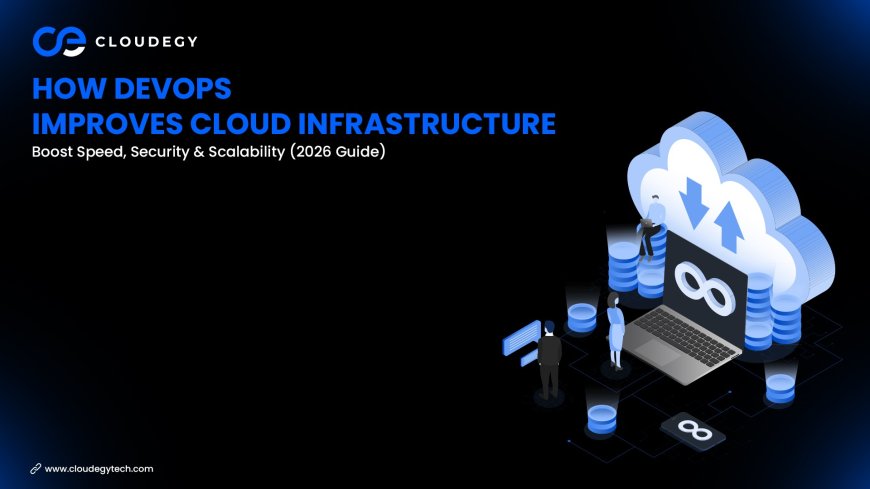
How DevOps Improves Cloud Infrastructure: Boost Speed, Security & Scalability (2026 Guide)
Cloud infrastructure has become the backbone of modern digital businesses. From startups to large enterprises, organizations rely on cloud environments to run applications, store data, and scale operations.

However, managing cloud infrastructure efficiently can be complex.
This is where DevOps plays a crucial role.
DevOps combines development and operations practices to improve automation, collaboration, and efficiency. When applied to cloud infrastructure, it enhances performance, security, and scalability.
In this guide, we’ll explore how DevOps improves cloud infrastructure and why it’s essential for modern businesses.
What is Cloud Infrastructure?
Cloud infrastructure refers to the virtual components required to support cloud computing, including:
• Servers
• Storage systems
• Networking
• Virtual machines
• Databases
These resources are delivered over the internet, allowing businesses to operate without physical hardware.
What is DevOps in Cloud Computing?
DevOps in cloud computing focuses on:
• Automating infrastructure management
• Improving collaboration between teams
• Accelerating deployment processes
• Enhancing system reliability
It helps organizations manage cloud environments more efficiently.
Why Cloud Infrastructure Needs DevOps
Managing cloud infrastructure without DevOps can lead to:
• Manual errors
• Slow deployments
• Security risks
• Inefficient resource usage
DevOps solves these issues by introducing automation and continuous processes.
How DevOps Improves Cloud Infrastructure
1. Automation of Infrastructure
DevOps automates repetitive tasks such as:
• Server provisioning
• Configuration management
• Deployment
This reduces human errors and saves time.
2. Infrastructure as Code (IaC)
With IaC, infrastructure is managed using code.
Benefits include:
• Consistency across environments
• Faster deployments
• Easy scalability
Teams can replicate infrastructure quickly.
3. Faster Deployment with CI/CD
DevOps enables Continuous Integration and Continuous Deployment (CI/CD).
This allows:
• Frequent updates
• Faster release cycles
• Reduced downtime
Applications can be deployed quickly and efficiently.
4. Improved Scalability
Cloud environments require flexibility.
DevOps helps by:
• Automatically scaling resources
• Managing traffic spikes
• Ensuring performance stability
5. Enhanced Security (DevSecOps)
Security is integrated into the DevOps process.
This includes:
• Automated security testing
• Vulnerability scanning
• Access control
Security becomes part of the development lifecycle.
6. Better Monitoring and Logging
DevOps tools provide real-time insights into system performance.
Benefits include:
• Early issue detection
• Improved system reliability
• Faster troubleshooting
7. Cost Optimization
DevOps helps reduce cloud costs by:
• Automating resource usage
• Eliminating unused resources
• Improving efficiency
Businesses only pay for what they use.
8. Improved Collaboration
DevOps brings development and operations teams together.
This results in:
• Better communication
• Faster problem-solving
• Efficient workflows
9. High Availability and Reliability
DevOps ensures systems remain available and stable.
This is achieved through:
• Automated recovery
• Load balancing
• Continuous monitoring
10. Faster Innovation
With streamlined processes, businesses can:
• Experiment with new features
• Deploy updates quickly
• Stay ahead of competitors
Key DevOps Tools for Cloud Infrastructure
DevOps relies on various tools:
Version Control
• Git
CI/CD Tools
• Jenkins
• GitHub Actions
Configuration Management
• Ansible
Containerization
• Docker
Orchestration
• Kubernetes
Monitoring
• Prometheus
• Grafana
Real-World Use Cases
Startups
Quickly deploy applications and scale infrastructure.
Enterprises
Manage large-scale cloud environments efficiently.
IT Companies
Deliver reliable services to clients.
E-commerce Platforms
Handle high traffic and ensure smooth performance.
Role of Cloud Storage in DevOps
Cloud storage plays a key role in DevOps by enabling:
• Easy file access
• Secure data management
• Seamless collaboration
Platforms like Cloudegy Drive help teams manage and share files efficiently.
👉 Get started: https://drive.cloudegytech.com/
Best Practices for DevOps in Cloud Infrastructure
To maximize benefits:
• Use Infrastructure as Code
• Automate deployments
• Monitor systems continuously
• Implement security practices
• Optimize resource usage
Challenges in DevOps Cloud Integration
Some challenges include:
• Tool complexity
• Security concerns
• Skill gaps
• Integration issues
Proper planning helps overcome these challenges.
Future of DevOps in Cloud Infrastructure
The future includes:
• AI-driven automation
• Serverless architecture
• Advanced monitoring tools
• Enhanced security frameworks
DevOps will continue to evolve with cloud technology.
Conclusion
DevOps has become essential for managing cloud infrastructure efficiently.
By enabling automation, scalability, and improved collaboration, DevOps helps businesses:
• Deploy faster
• Reduce costs
• Improve security
• Enhance performance
In today’s digital world, combining DevOps with cloud infrastructure is the key to success.
What's Your Reaction?
 Like
0
Like
0
 Dislike
0
Dislike
0
 Love
0
Love
0
 Funny
0
Funny
0
 Angry
0
Angry
0
 Sad
0
Sad
0
 Wow
0
Wow
0