






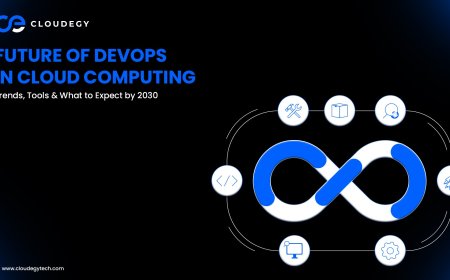


Future of DevOps in Cloud Computing: Trends, Tools & What to Expect by 2030
The rapid evolution of cloud computing has transformed how businesses build, deploy, and scale applications. At the center of this transformation lies DevOps, a methodology that bridges development and operations through automation and collaboration.

As technology advances, the future of DevOps in cloud computing is becoming even more powerful, intelligent, and essential.
In this blog, we explore upcoming trends, innovations, and what businesses can expect from DevOps in the coming years.
What is DevOps in Cloud Computing?
DevOps in cloud computing refers to the integration of development and operations practices using cloud platforms.
It focuses on:
• Automation
• Continuous Integration & Deployment (CI/CD)
• Monitoring
• Collaboration
This combination enables faster delivery, improved reliability, and scalable infrastructure.
Why DevOps is Critical for the Future
Modern businesses require:
• Speed
• Scalability
• Security
• Continuous innovation
DevOps provides all these capabilities, making it a key driver of digital transformation.
Key Trends Shaping the Future of DevOps
1. AI and Machine Learning in DevOps (AIOps)
Artificial Intelligence is transforming DevOps.
With AIOps:
• Systems can detect issues automatically
• Predict failures before they occur
• Optimize performance in real time
This reduces downtime and improves efficiency.
2. Rise of DevSecOps
Security is no longer optional.
DevSecOps integrates security into every stage of development.
Future benefits include:
• Automated security testing
• Real-time threat detection
• Secure cloud environments
3. Serverless Architecture
Serverless computing is gaining popularity.
Benefits include:
• No infrastructure management
• Automatic scaling
• Cost efficiency
DevOps will adapt to manage serverless environments seamlessly.
4. Cloud-Native Development
Applications are now built specifically for the cloud.
Cloud-native DevOps enables:
• Faster deployments
• Microservices architecture
• Containerization
5. Infrastructure as Code (IaC) Evolution
IaC will become more advanced.
Future improvements:
• Automated infrastructure scaling
• Error-free deployments
• Faster environment setup
6. Advanced CI/CD Pipelines
CI/CD pipelines will become smarter.
Enhancements include:
• AI-driven testing
• Faster deployment cycles
• Continuous feedback
7. Edge Computing Integration
Edge computing processes data closer to users.
DevOps will support:
• Faster data processing
• Reduced latency
• Real-time applications
8. Increased Automation
Automation will dominate DevOps processes.
This includes:
• Deployment automation
• Monitoring automation
• Security automation
9. Observability and Monitoring
Future DevOps will focus on deep observability.
This means:
• Real-time insights
• Predictive analytics
• Better system performance
10. Multi-Cloud and Hybrid Cloud Strategies
Businesses are adopting multiple cloud platforms.
DevOps will enable:
• Seamless integration
• Cross-platform management
• Improved flexibility
Role of Cloud Platforms in DevOps Future
Cloud platforms provide the foundation for DevOps innovation by offering:
• Scalable infrastructure
• Flexible environments
• Cost-efficient solutions
Cloud storage solutions like Cloudegy Drive play a vital role by enabling:
• Secure data storage
• Easy file sharing
• Global accessibility
👉 Get started: https://drive.cloudegytech.com/
Benefits of Future DevOps in Cloud Computing
Faster Innovation
Businesses can launch new features quickly.
Improved Security
Integrated security reduces risks.
Better Scalability
Systems can handle growth efficiently.
Cost Optimization
Automation reduces operational costs.
Enhanced Collaboration
Teams work together more effectively.
Challenges in Future DevOps Adoption
Despite its benefits, challenges include:
• Skill gaps
• Tool complexity
• Security concerns
• Integration issues
Organizations must invest in training and strategy.
Best Practices to Prepare for the Future
To stay ahead:
• Adopt automation early
• Use cloud-native tools
• Focus on security
• Implement CI/CD pipelines
• Monitor continuously
Real-World Applications
Startups
Scale quickly with minimal resources.
Enterprises
Manage complex cloud environments efficiently.
IT Companies
Deliver faster and more reliable services.
E-commerce Platforms
Handle high traffic and ensure uptime.
Future Technologies Impacting DevOps
The future will be influenced by:
• Artificial Intelligence
• Blockchain
• Internet of Things (IoT)
• 5G Technology
These technologies will enhance DevOps capabilities.
Conclusion
The future of DevOps in cloud computing is bright and transformative.
With advancements in AI, automation, security, and cloud-native technologies, DevOps will continue to evolve and drive innovation.
Businesses that adopt these trends early will gain a competitive advantage, improve efficiency, and scale faster.
In the coming years, DevOps will not just support cloud computing—it will define it.
What's Your Reaction?
 Like
0
Like
0
 Dislike
0
Dislike
0
 Love
0
Love
0
 Funny
0
Funny
0
 Angry
0
Angry
0
 Sad
0
Sad
0
 Wow
0
Wow
0