











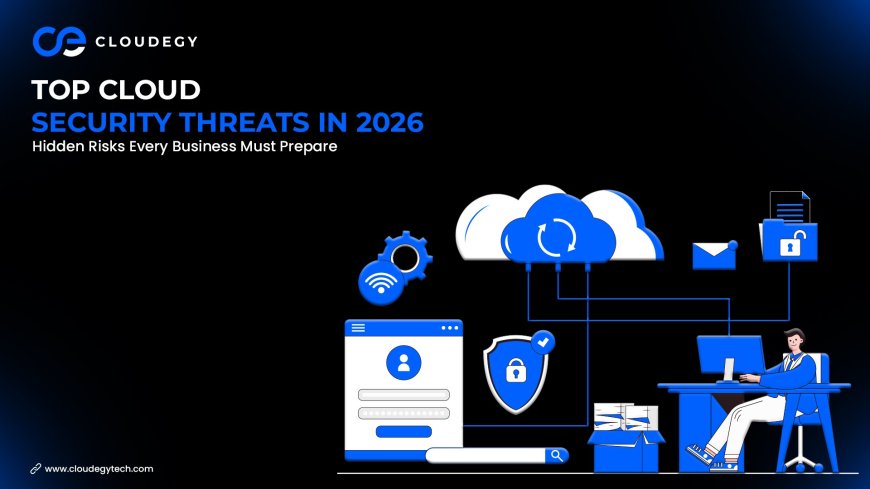
Top Cloud Security Threats in 2026: Hidden Risks Every Business Must Prepare For
Discover the top cloud security threats in 2026 and how to protect your business from data breaches, cyberattacks, and cloud vulnerabilities.

Cloud computing has revolutionized how businesses operate, offering flexibility, scalability, and cost efficiency. However, as cloud adoption continues to grow in 2026, so do the risks associated with it.
Cybercriminals are becoming more sophisticated, targeting cloud environments with advanced attack methods. Understanding these threats is essential for businesses to stay secure and resilient.
In this guide, we’ll explore the top cloud security threats in 2026 and how organizations can protect themselves effectively.
☁️ Why Cloud Security Threats Are Increasing
The rise in cloud security threats is driven by several factors:
- Rapid digital transformation
- Increased remote work environments
- Misconfigured cloud systems
- Lack of security awareness
👉 As more businesses move to the cloud, attackers are following.
🚨 Top Cloud Security Threats in 2026
1. 🔓 Misconfigured Cloud Settings
Misconfiguration remains one of the biggest threats in cloud security.
Examples:
- Publicly exposed storage buckets
- Incorrect access permissions
- Unsecured APIs
👉 Even a small configuration error can expose sensitive data.
Prevention:
- Regular audits
- Automated configuration checks
- Access control policies
2. 🧑💻 Data Breaches
Data breaches continue to be a major concern.
Causes:
- Weak passwords
- Lack of encryption
- Insider threats
Impact:
- Financial loss
- Reputation damage
- Legal consequences
👉 Protecting sensitive data is critical for business survival.
3. 🔐 Weak Identity & Access Management (IAM)
Poor IAM practices can lead to unauthorized access.
Risks:
- Overprivileged users
- Lack of multi-factor authentication
- Shared credentials
Solution:
- Implement least privilege principle
- Enable MFA
- Regularly review user roles
4. 🦠 Ransomware Attacks
Ransomware is evolving and targeting cloud environments.
How it works:
- Attackers encrypt your data
- Demand payment for access
Why it’s dangerous:
- Can halt business operations
- Causes data loss
Prevention:
- Regular backups
- Endpoint protection
- Security monitoring
5. 🌐 API Vulnerabilities
APIs are essential for cloud services but can be exploited.
Common issues:
- Lack of authentication
- Poor encryption
- Exposed endpoints
Prevention:
- Secure API gateways
- Use tokens and authentication
- Monitor API traffic
6. 👤 Insider Threats
Not all threats come from outside.
Types:
- Malicious employees
- Negligent users
Impact:
- Data leaks
- Unauthorized access
Prevention:
- User activity monitoring
- Role-based access control
- Employee training
7. ⚙️ Insecure Interfaces & Applications
Applications running in the cloud can have vulnerabilities.
Risks:
- Poor coding practices
- Lack of updates
- Security loopholes
Solution:
- Regular testing
- Secure development practices
- Patch management
8. 🌍 Distributed Denial of Service (DDoS) Attacks
DDoS attacks flood systems with traffic, causing downtime.
Impact:
- Service disruption
- Loss of revenue
Prevention:
- Load balancing
- Traffic filtering
- DDoS protection services
9. 🔍 Lack of Visibility & Monitoring
Without proper monitoring, threats can go unnoticed.
Risks:
- Delayed response to attacks
- Hidden vulnerabilities
Solution:
- Real-time monitoring tools
- Security dashboards
- Log analysis
10. 🧩 Multi-Cloud Complexity
Many businesses use multiple cloud providers.
Challenges:
- Complex security management
- Inconsistent policies
Solution:
- Centralized security systems
- Unified policies
🛡️ How to Protect Against Cloud Security Threats
✅ 1. Implement Strong Access Controls
Use role-based access and limit permissions.
✅ 2. Enable Encryption Everywhere
Protect data at rest and in transit.
✅ 3. Regular Security Audits
Identify and fix vulnerabilities proactively.
✅ 4. Continuous Monitoring
Track activities and detect threats in real time.
✅ 5. Backup & Disaster Recovery
Ensure quick recovery in case of attacks.
✅ 6. Employee Awareness
Train staff to recognize and prevent threats.
🚀 Future of Cloud Security
Cloud security in 2026 is evolving with:
- AI-driven threat detection
- Zero Trust Architecture
- Automated security systems
- Advanced encryption methods
👉 Businesses must adapt to stay protected.
🏁 Conclusion
Cloud computing offers incredible benefits, but it also comes with serious security risks.
By understanding the top cloud security threats in 2026 and implementing strong security practices, businesses can protect their data, maintain trust, and ensure long-term success.
👉 Security is not a one-time effort—it’s an ongoing process.
What's Your Reaction?
 Like
0
Like
0
 Dislike
0
Dislike
0
 Love
0
Love
0
 Funny
0
Funny
0
 Angry
0
Angry
0
 Sad
0
Sad
0
 Wow
0
Wow
0