












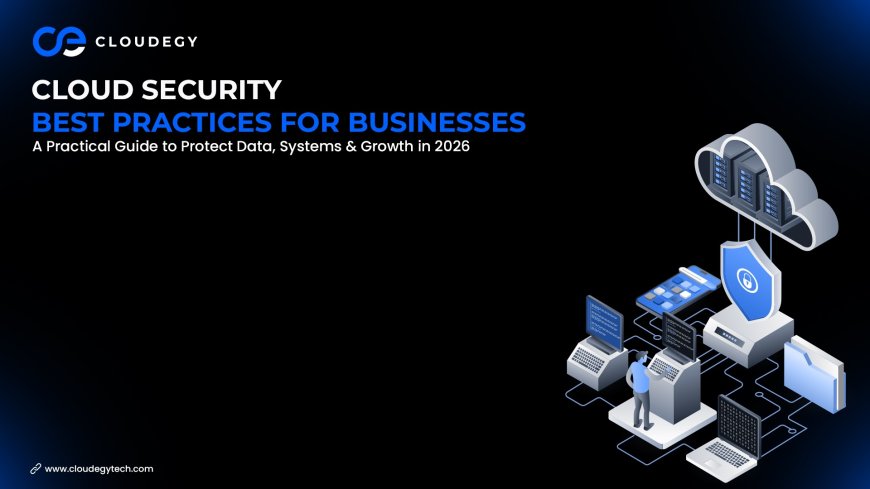
Cloud Security Best Practices for Businesses: A Practical Guide to Protect Data, Systems & Growth in 2026
Learn the top cloud security best practices for businesses in 2026. Protect your data, applications, and infrastructure from cyber threats effectively.

Cloud computing has become essential for modern businesses, enabling flexibility, scalability, and faster innovation. However, as organizations increasingly rely on cloud platforms, ensuring strong security becomes more critical than ever.
Cyber threats are evolving rapidly in 2026, and businesses that fail to implement proper cloud security measures risk data breaches, financial losses, and reputational damage.
This guide outlines the most effective cloud security best practices for businesses to help protect data, applications, and infrastructure while ensuring long-term growth.
☁️ Why Cloud Security Matters for Businesses
Cloud environments store sensitive business data, including customer information, financial records, and intellectual property. Without proper protection, this data becomes a prime target for cybercriminals.
Key reasons cloud security is important:
- Protects sensitive business data
- Ensures regulatory compliance
- Prevents financial losses
- Maintains customer trust
- Supports business continuity
👉 Cloud security is not optional—it is a business necessity.
🔐 1. Implement Strong Identity & Access Management (IAM)
One of the most critical aspects of cloud security is controlling who can access your systems.
Best Practices:
- Use role-based access control (RBAC)
- Apply the principle of least privilege
- Regularly review user permissions
- Avoid shared accounts
👉 Only authorized users should access sensitive resources.
🔑 2. Enable Multi-Factor Authentication (MFA)
Passwords alone are no longer enough to protect cloud systems.
Why MFA is important:
- Adds an extra layer of security
- Prevents unauthorized access
- Reduces risk of credential theft
👉 Always enable MFA for all users, especially administrators.
🔒 3. Encrypt Data at All Levels
Encryption ensures that even if data is accessed, it cannot be read without proper authorization.
Types of encryption:
- Data at rest
- Data in transit
- End-to-end encryption
👉 Encryption is a must-have for protecting sensitive data.
🛡️ 4. Regular Security Audits & Assessments
Security is not a one-time task. Regular audits help identify vulnerabilities before attackers exploit them.
What to check:
- Misconfigured cloud settings
- Weak passwords
- Unused accounts
- Security gaps
👉 Proactive audits reduce risk significantly.
⚙️ 5. Secure Cloud Configurations
Misconfigurations are one of the leading causes of cloud breaches.
Common mistakes:
- Publicly exposed storage
- Open ports
- Improper permissions
Solution:
- Use automated tools
- Follow cloud provider guidelines
- Conduct regular configuration checks
🧑💻 6. Monitor & Detect Threats in Real-Time
Continuous monitoring helps detect suspicious activities early.
Tools to use:
- Security Information and Event Management (SIEM)
- Cloud monitoring dashboards
- AI-based threat detection systems
👉 Early detection prevents major damage.
🔄 7. Backup & Disaster Recovery Planning
Data loss can occur due to cyberattacks, system failures, or human errors.
Best Practices:
- Schedule regular backups
- Store backups in secure locations
- Test recovery processes
👉 Always be prepared for worst-case scenarios.
🌐 8. Secure APIs & Applications
APIs and applications are common entry points for attackers.
Best Practices:
- Use authentication tokens
- Encrypt API traffic
- Regularly update software
- Perform vulnerability testing
👉 Secure development practices are essential.
👤 9. Train Employees on Cybersecurity
Human error is a major cause of security breaches.
Training topics:
- Phishing awareness
- Password management
- Safe data handling
👉 Educated employees are your first line of defense.
🧩 10. Adopt a Zero Trust Security Model
Zero Trust assumes that no user or system is trusted by default.
Key principles:
- Verify every access request
- Continuously monitor users
- Limit access strictly
👉 Trust nothing, verify everything.
🏢 Cloud Security for Growing Businesses
As businesses scale, cloud security must evolve accordingly.
Key considerations:
- Scalable security solutions
- Centralized monitoring systems
- Compliance management
- Multi-cloud security strategies
👉 Growth without security is a risk.
⚠️ Common Cloud Security Mistakes to Avoid
- Ignoring updates and patches
- Weak password policies
- Lack of monitoring
- Overlooking insider threats
- Poor backup strategies
👉 Avoiding these mistakes can significantly improve security.
🚀 Future Trends in Cloud Security
Cloud security is evolving with technology advancements:
- AI-powered threat detection
- Automated security operations
- Blockchain-based data protection
- Advanced encryption methods
👉 Businesses must stay updated to remain secure.
🏁 Conclusion
Cloud security is a critical component of modern business success. With increasing cyber threats in 2026, implementing strong security practices is essential to protect data, maintain trust, and ensure operational continuity.
By following these cloud security best practices, businesses can build a secure and resilient cloud environment that supports growth and innovation.
👉 Security is not just about protection—it’s about enabling safe business growth.
What's Your Reaction?
 Like
0
Like
0
 Dislike
0
Dislike
0
 Love
0
Love
0
 Funny
0
Funny
0
 Angry
0
Angry
0
 Sad
0
Sad
0
 Wow
0
Wow
0