





Role of Cloud in Big Data Analytics: How Businesses Turn Data into Decisions in 2026
Discover how cloud computing powers big data analytics. Learn benefits, use cases, tools, and strategies to turn data into actionable insights in 2026.

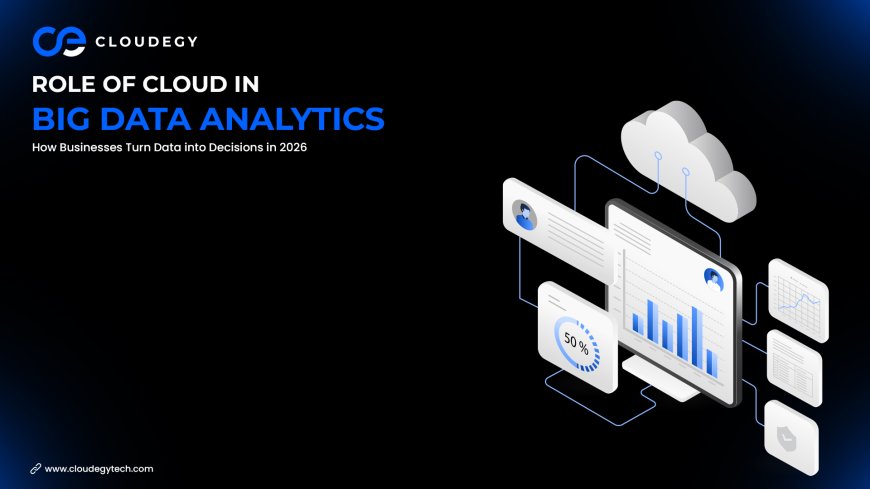
Data has become one of the most valuable assets for modern businesses. Every interaction, transaction, and process generates data that can be analyzed to gain insights and improve decision-making.
However, managing and analyzing massive volumes of data—commonly known as big data—requires powerful infrastructure.
This is where cloud computing plays a critical role.
Cloud technology provides scalable, flexible, and cost-effective solutions that enable businesses to store, process, and analyze large datasets efficiently.
In 2026, cloud computing is the backbone of big data analytics, helping organizations transform raw data into meaningful insights.
📊 What is Big Data Analytics?
Big data analytics refers to the process of analyzing large and complex datasets to uncover patterns, trends, and insights.
It involves:
- Data collection
- Data storage
- Data processing
- Data visualization
👉 The goal is to make better business decisions.
☁️ What is Cloud Computing in Big Data?
Cloud computing provides on-demand access to computing resources required for big data analytics.
It enables:
- Scalable storage
- High-performance processing
- Remote access to analytics tools
- Cost-effective infrastructure
👉 Cloud eliminates the need for expensive on-premise systems.
🔗 How Cloud Supports Big Data Analytics
Cloud computing supports every stage of the big data lifecycle.
💾 1. Data Storage
Cloud platforms provide virtually unlimited storage capacity.
👉 Store massive datasets without limitations.
⚡ 2. Data Processing
High-performance computing enables fast data processing.
👉 Analyze large datasets quickly.
📊 3. Data Analysis
Cloud tools support advanced analytics and machine learning.
👉 Extract meaningful insights.
🌐 4. Data Accessibility
Access data and analytics tools from anywhere.
🔄 5. Data Integration
Combine data from multiple sources easily.
👉 Cloud simplifies big data management.
🌟 Key Benefits of Cloud in Big Data Analytics
📈 1. Scalability
Easily scale resources based on data volume.
💰 2. Cost Efficiency
No need for expensive hardware investments.
⚡ 3. High Performance
Process large datasets quickly and efficiently.
🌍 4. Global Accessibility
Access analytics tools and data from anywhere.
🔐 5. Enhanced Security
Protect data with advanced security features.
🧠 6. Advanced Analytics Capabilities
Support AI, machine learning, and predictive analytics.
🔄 7. Real-Time Processing
Analyze data as it is generated.
👉 Cloud enables faster and smarter decision-making.
🧩 Key Components of Cloud-Based Big Data Systems
🖥️ 1. Compute Resources
Process large datasets efficiently.
💾 2. Storage Systems
Store structured and unstructured data.
📊 3. Analytics Tools
Perform data analysis and visualization.
🌐 4. Networking
Ensure fast data transfer.
🔐 5. Security Systems
Protect sensitive data.
👉 These components work together to power analytics.
🛠️ Popular Use Cases
🛒 E-commerce
- Customer behavior analysis
- Personalized recommendations
🏦 Finance
- Fraud detection
- Risk analysis
🏥 Healthcare
- Patient data analysis
- Disease prediction
🎯 Marketing
- Campaign optimization
- Customer segmentation
🚚 Logistics
- Route optimization
- Demand forecasting
👉 Big data analytics drives innovation across industries.
🛡️ Best Practices
🔐 Ensure Data Security
Use encryption and access control.
⚙️ Optimize Data Storage
Store only necessary data efficiently.
🔄 Automate Processes
Use automation for data processing.
📊 Monitor Performance
Track system performance regularly.
💰 Manage Costs
Avoid unnecessary resource usage.
⚠️ Challenges
🔐 Data Privacy
Protecting sensitive information.
⚙️ Complexity
Managing large-scale data systems.
💰 Cost Management
Handling high processing costs.
🔄 Integration Issues
Combining data from multiple sources.
👉 Proper strategy is essential.
🔮 Future Trends
🤖 AI-Driven Analytics
AI will enhance data analysis capabilities.
⚡ Real-Time Analytics
Faster insights for decision-making.
🌐 Edge + Cloud Integration
Combining edge computing with cloud analytics.
🧠 Predictive & Prescriptive Analytics
Forecast trends and recommend actions.
👉 The future is data-driven.
🏁 Conclusion
Cloud computing has revolutionized big data analytics by providing scalable, efficient, and cost-effective solutions.
It enables businesses to process massive datasets, gain insights, and make data-driven decisions faster than ever before.
As data continues to grow, the role of cloud in big data analytics will become even more critical.
👉 Businesses that leverage cloud-powered analytics will lead the future.
What's Your Reaction?
 Like
0
Like
0
 Dislike
0
Dislike
0
 Love
0
Love
0
 Funny
0
Funny
0
 Angry
0
Angry
0
 Sad
0
Sad
0
 Wow
0
Wow
0