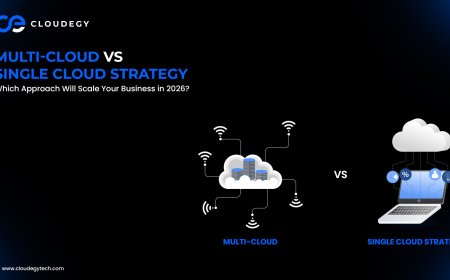

Multi-Cloud vs Hybrid Cloud: Which Strategy Actually Works Better for Businesses in 2026?
As businesses increasingly adopt cloud computing, choosing the right cloud strategy has become more important than ever. Two of the most commonly discussed approaches are multi-cloud and hybrid cloud.

While both offer flexibility and scalability, they serve different purposes and solve different challenges.
So, which one is better for your business?
In this guide, we’ll break down the differences, benefits, and real-world use cases to help you make the right decision.
Understanding Multi-Cloud
Multi-cloud refers to the use of multiple cloud service providers at the same time.
Instead of relying on a single provider, businesses distribute their workloads across different platforms.
Key Features of Multi-Cloud
• Uses multiple public cloud providers
• Avoids vendor lock-in
• Improves flexibility
• Allows best-of-breed services
Understanding Hybrid Cloud
Hybrid cloud combines on-premise infrastructure with cloud services.
It allows businesses to keep some systems locally while moving others to the cloud.
Key Features of Hybrid Cloud
• Mix of private and public cloud
• Greater control over sensitive data
• Flexible workload distribution
• Gradual cloud adoption
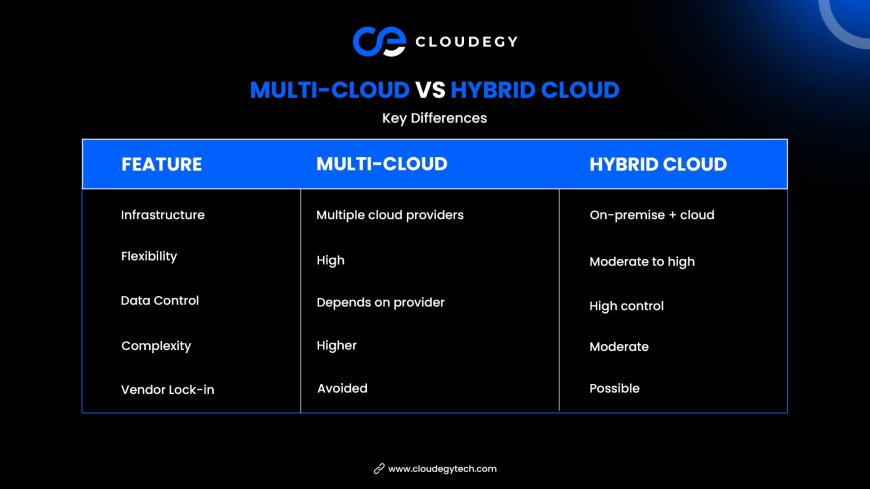
Multi-Cloud vs Hybrid Cloud: Key Differences
Benefits of Multi-Cloud Strategy
1. No Vendor Lock-In
Businesses are not dependent on a single provider.
2. Best Services from Each Provider
You can choose:
• One provider for storage
• Another for computing
• Another for AI tools
3. Improved Reliability
If one provider fails, others can take over.
4. Global Performance
Use providers with data centers closer to users.
Benefits of Hybrid Cloud Strategy
1. Greater Data Control
Sensitive data stays on-premise.
2. Enhanced Security
Better control over critical systems.
3. Cost Optimization
Use cloud for scaling, local systems for core tasks.
4. Gradual Migration
Move to the cloud step-by-step.
Challenges of Multi-Cloud
Despite its advantages, multi-cloud has challenges:
• Complex management
• Higher operational overhead
• Integration issues
• Need for skilled teams
Challenges of Hybrid Cloud
Hybrid cloud also has limitations:
• Infrastructure maintenance
• Integration complexity
• Higher initial setup cost
When Should You Choose Multi-Cloud?
Multi-cloud is ideal when:
• You want maximum flexibility
• You need high availability
• You want to avoid vendor lock-in
• You use advanced cloud services
When Should You Choose Hybrid Cloud?
Hybrid cloud works best when:
• You have sensitive data
• You need regulatory compliance
• You want gradual cloud adoption
• You already have on-premise systems
Role of Cloud Storage in Both Models
Regardless of strategy, cloud storage plays a key role.
It enables:
• Secure data access
• Easy file sharing
• Centralized storage
Solutions like Cloudegy Drive help businesses:
• Store data securely
• Share files easily
• Access files from anywhere
👉 https://drive.cloudegytech.com/
Multi-Cloud vs Hybrid Cloud: Real-World Example
Multi-Cloud Example
A global company uses:
• One provider for analytics
• Another for storage
• Another for AI services
This ensures flexibility and performance.
Hybrid Cloud Example
A financial company:
• Stores sensitive data locally
• Uses cloud for applications
This ensures security and scalability.
Which is Better for Your Business?
There is no one-size-fits-all answer.
Choose based on:
• Business size
• Security needs
• Budget
• Technical expertise
• Growth plans
Future of Cloud Strategies
Cloud strategies are evolving with:
• AI-driven cloud management
• Multi-cloud automation tools
• Hybrid cloud expansion
• Edge computing integration
Businesses will increasingly combine both models.
Best Practices for Choosing the Right Strategy
To make the right decision:
• Assess your business needs
• Understand your data sensitivity
• Evaluate costs
• Plan for scalability
• Ensure strong security
Conclusion
Both multi-cloud and hybrid cloud offer powerful advantages.
Multi-cloud provides flexibility and freedom, while hybrid cloud offers control and security.
The best choice depends on your business goals and infrastructure.
In many cases, businesses may even combine both strategies for maximum efficiency.
The key is to choose a solution that aligns with your long-term vision and operational needs.
What's Your Reaction?
 Like
0
Like
0
 Dislike
0
Dislike
0
 Love
0
Love
0
 Funny
0
Funny
0
 Angry
0
Angry
0
 Sad
0
Sad
0
 Wow
0
Wow
0