




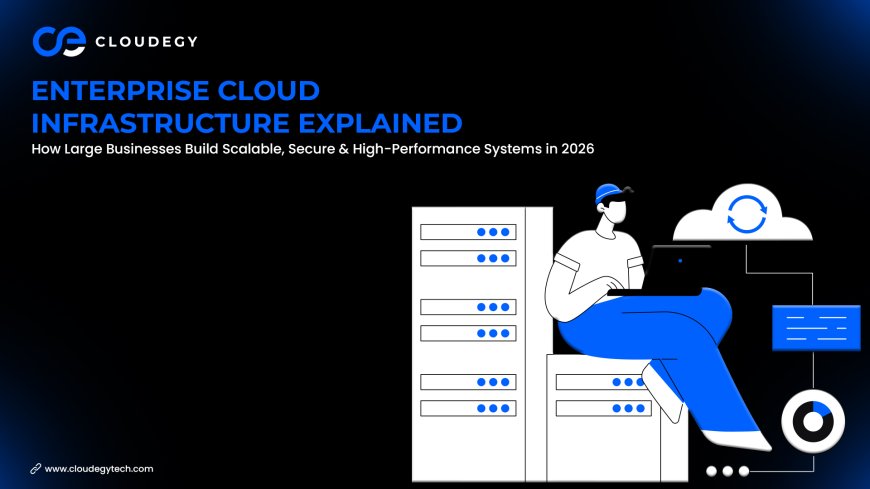
Enterprise Cloud Infrastructure Explained: How Large Businesses Build Scalable, Secure & High-Performance Systems in 2026
Learn enterprise cloud infrastructure in 2026. Discover architecture, benefits, and strategies to build scalable, secure, and high-performance cloud systems.

In today’s digital economy, enterprises rely heavily on technology to deliver services, manage operations, and stay competitive. Traditional IT systems are no longer enough to handle the scale, speed, and complexity of modern business environments.
This is where enterprise cloud infrastructure comes into play.
Cloud infrastructure enables large organizations to build powerful, scalable, and flexible systems without the limitations of physical hardware.
In this guide, we’ll break down enterprise cloud infrastructure, its key components, benefits, and how businesses can design a robust cloud environment in 2026.
☁️ What is Enterprise Cloud Infrastructure?
Enterprise cloud infrastructure refers to a large-scale cloud computing environment designed to support complex business operations, applications, and data management needs.
It includes:
- Compute resources (servers, virtual machines)
- Storage systems
- Networking
- Security frameworks
👉 It’s the backbone of modern enterprise IT systems.
🚀 Why Enterprises are Moving to the Cloud
Large organizations are shifting to cloud infrastructure for several reasons:
- Increased scalability
- Cost efficiency
- Improved performance
- Global accessibility
- Enhanced security
👉 Cloud enables enterprises to operate at scale.
🧩 Key Components of Enterprise Cloud Infrastructure
🖥️ 1. Compute Resources
Virtual machines and containers power applications.
👉 Flexible and scalable computing.
💾 2. Storage Systems
Cloud storage solutions for structured and unstructured data.
Types:
- Object storage
- Block storage
- File storage
🌐 3. Networking
Ensures communication between systems.
Includes:
- Virtual networks
- Load balancers
- Firewalls
🔐 4. Security Framework
Protects data and infrastructure.
Includes:
- Encryption
- Identity & Access Management (IAM)
- Threat detection
⚙️ 5. Management & Monitoring Tools
Track performance and security.
👉 Visibility is critical for large systems.
🌟 Benefits of Enterprise Cloud Infrastructure
📈 1. Scalability
Handle massive workloads and traffic spikes.
👉 Scale resources instantly.
💰 2. Cost Optimization
Reduce capital expenditure on hardware.
👉 Pay-as-you-go model.
⚡ 3. High Performance
Optimized infrastructure ensures fast processing.
🌍 4. Global Reach
Deploy services worldwide with ease.
🔐 5. Advanced Security
Enterprise-grade security features protect sensitive data.
🔄 6. Reliability & Availability
High uptime with redundancy and failover systems.
🧠 7. Innovation Enablement
Supports AI, big data, and advanced technologies.
🏢 Types of Enterprise Cloud Models
🌍 Public Cloud
Shared infrastructure managed by providers.
👉 Cost-effective and scalable.
🏠 Private Cloud
Dedicated infrastructure for a single organization.
👉 More control and security.
🔄 Hybrid Cloud
Combination of public and private cloud.
👉 Flexibility and control.
🌐 Multi-Cloud
Using multiple cloud providers.
👉 Avoid vendor lock-in.
🛡️ Best Practices for Enterprise Cloud Infrastructure
🔐 Implement Strong Security
- Use encryption
- Apply access controls
- Monitor threats
⚙️ Automate Operations
Automation improves efficiency and reduces errors.
🔍 Monitor Continuously
Track performance and detect issues early.
🔄 Backup & Disaster Recovery
Ensure business continuity.
🧠 Train IT Teams
Keep teams updated with latest technologies.
⚠️ Common Challenges
- Complex architecture
- Security risks
- Cost management
- Integration issues
👉 Proper planning is essential.
🚀 Enterprise Cloud Architecture Strategy
To build a strong infrastructure:
1. Define business requirements
2. Choose the right cloud model
3. Design scalable architecture
4. Implement security measures
5. Monitor and optimize
👉 Strategy drives success.
🔮 Future of Enterprise Cloud Infrastructure
The future includes:
- AI-driven cloud management
- Serverless architecture
- Edge computing
- Advanced automation
👉 Enterprises will become more cloud-native.
🏁 Conclusion
Enterprise cloud infrastructure is the foundation of modern business operations.
It enables organizations to scale, innovate, and compete in a fast-changing digital landscape.
By adopting the right architecture and security practices, enterprises can build a powerful and future-ready cloud environment.
👉 The stronger your infrastructure, the stronger your business.
What's Your Reaction?
 Like
0
Like
0
 Dislike
0
Dislike
0
 Love
0
Love
0
 Funny
0
Funny
0
 Angry
0
Angry
0
 Sad
0
Sad
0
 Wow
0
Wow
0